Buying prepared gildas for hospitality or assembling them in the kitchen is not a decision that should be made by comparing product prices alone. To choose wisely, you need to consider the cost per unit served, preparation time, ingredient management, wastage, the uniformity of the pieces and the type of service.
In-house assembly allows you to define the recipe and adjust each combination. Buying the prepared product transfers the making of the piece to the supplier, although the business remains responsible for receiving, storing, handling and serving it. A third option also exists: combining both approaches according to demand and the food offering.
For restaurants, hotels, caterers and contract catering companies, the most useful question is not “which option is better?” but “which solution suits our operations, and what data do we need to check it?”.
What are you really comparing when buying gildas?
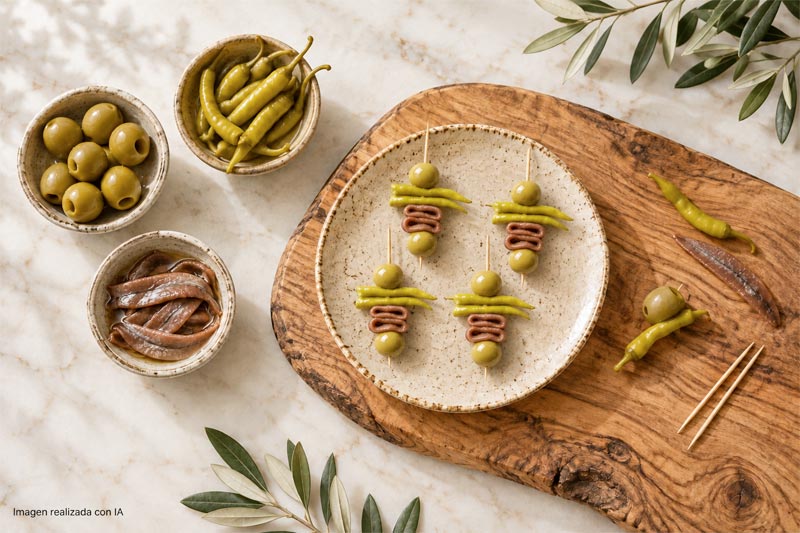
An assembled gilda and its separate ingredients do not represent exactly the same purchase. In the first case, you buy a finished combination; in the second, you buy raw materials that must be turned into a finished product on the premises.
For that reason, comparing the price of a tray of gildas with the cost of olives, piparras and anchovies gives an incomplete picture. Between receiving the ingredients and serving the aperitif, there are tasks, costs and decisions that must also be taken into account.
Before requesting quotations, it is worth defining the piece you want to serve:
- Ingredients and the proportion of each.
- Approximate size of each bite.
- Flavour profile and level of heat.
- Presentation and arrangement on the skewer.
- Number of units per serving.
- Intended finish or accompaniment.
Without this definition, it is easy to compare different products. A combination with a different quantity of fish, a different olive size or a different composition may carry a different price without that telling you which option is more suitable.
Purchase cost and cost per unit served
The first step is to separate the purchase price from the operating cost. To make a professional decision, you need to know how much it costs to put a unit that matches the recipe in front of the customer.
What to include for kitchen assembly
The calculation for in-house assembly should include, at the very least:
- The cost of the ingredients actually used.
- The real yield of each pack.
- Cocktail sticks or other assembly items.
- Preparation time.
- Losses during handling.
- Pieces discarded or never served.
- Consumables and the specific cleaning tasks associated with preparation.
Not all of these items will carry the same weight in every business. What matters is to apply a consistent approach and to avoid one option including costs that are left out of the other.
What to include for the prepared gilda
For the prepared product, the comparison should start from the real number of usable units and add the tasks that remain on the premises:
- Receipt and storage.
- Opening and handling the pack.
- Preparation for service.
- Plating or finishing.
- Management of leftovers.
- Possible discards.
Buying the assembled piece does not mean that all the work disappears. It means that part of the process is carried out before the product reaches the kitchen.
A simple formula to structure the analysis is: cost per unit served = costs attributable to the period ÷ units actually served.
The denominator matters. Dividing by units bought or assembled can hide the effect of those that are ultimately not sold or used.
Preparation time: measure before you decide
Time must be measured under the real conditions of the business. It is not enough to time how long one person takes to thread three ingredients onto a cocktail stick.
To understand the full workload, the whole sequence needs to be observed: taking products out of storage, opening packs, setting up utensils, laying out ingredients, assembling, placing the pieces, labelling containers and cleaning the work area.
It is also worth distinguishing between total task time and staff occupation time. That difference helps you understand which resources are needed and when.
An internal trial can record:
- How many units are prepared.
- How long the entire process takes.
- How many people are involved.
- What incidents arise.
- How many pieces meet the intended presentation standard.
- How many actually reach service.
The useful figure is not a supposed standard time for the whole hospitality sector, but the result from your own operation.
In addition, freeing up time does not automatically mean reducing labour costs. It may allow resources to be devoted to other preparations or help to cope with a demand peak, but that benefit must be described accurately: available capacity, work reorganisation and actual financial savings are not the same thing.
Ingredient management and storage
Kitchen assembly requires several products to be coordinated. Each ingredient has its own supplier, format, identification, preservation requirements and rate of consumption.
The question is not only how much space each pack takes up. It also matters whether the components are used in other recipes or are bought solely to assemble gildas.
For example, a business that uses olives, piparras and fish in a variety of dishes can integrate those ingredients into its normal activity. In another business, the same purchase may leave several open packs with limited use.
To assess this, it helps to ask:
- Are the ingredients used in other dishes?
- Are they consumed at a similar rate?
- Which one usually runs out first?
- What quantities remain open at the end of service?
- How much space does each option need?
- What restocking frequency is workable?
The prepared product concentrates the assembly into a single product, but it should not be assumed that it always takes up less space or creates fewer storage needs. The answer depends on the pack, the units purchased, the preservation conditions and the delivery frequency.
Wastage: distinguishing loss from usable leftovers
To compare both options, you need to define what counts as wastage. An ingredient left in its pack and properly used in another preparation is not the same as a product that has to be discarded.
The records should distinguish between:
- Losses during preparation.
- Ingredients that do not meet the required specification.
- Assembled pieces that are never served.
- Leftovers used in other preparations.
- Product discarded because it has exceeded its conditions of use.
- Incidents at receipt or during handling.
The same logic must be applied to prepared gildas. Buying the finished product does not remove the possibility of leftovers, discards or inaccurate purchase forecasting.
To improve the decision, it is worth recording quantities and reasons. Knowing that units have been discarded is useful; knowing that this was due to over-ordering, poor presentation or insufficient turnover allows you to take action.
Uniformity and presentation of the pieces
Consistency should be part of the comparison from the outset. At a bar, buffet or event, a business may need units to maintain a coherent composition and appearance.
With in-house assembly, that consistency depends on ingredient selection, the definition of the recipe, work instructions and how they are carried out. When buying the prepared product, it must be verified through samples and specifications agreed with the supplier.
The aspects worth reviewing include:
- Proportion between ingredients.
- Size and ease of eating.
- Integrity of the components.
- Arrangement on the skewer.
- Behaviour during handling.
- Presentation after the piece has been placed on the serving dish.
The best test is not to look at a single unit in isolation. It is advisable to assess several pieces and reproduce the intended service: taking them out of the pack, arranging them on a plate or tray and checking whether they meet the business’s needs.
Recipe customisation
Kitchen assembly can be the right option when the business’s own recipe is central to its food offering. It allows you to decide the combination, proportions and finish, and to work with ingredients selected specifically for that preparation.
However, that flexibility requires the recipe to be kept under control. If an ingredient changes, the effects on flavour, cost, preservation and food information must be reviewed.
Buying prepared gildas starts from a defined product. Before choosing it, you need to check whether the available product fits the business’s offering and how much room there is to add your own finishing touch without altering the conditions of use.
It should not be assumed that a supplier offers recipe customisation. If that possibility is important, it should be raised explicitly and confirmed together with minimum quantities and other conditions.
Preservation and food safety
Neither in-house assembly nor buying prepared gildas relieves the business of its responsibility to control the product.
For ingredients bought separately, the conditions of each product must be respected, and the conditions applying to the final preparation must be established within the business’s own food safety management system. The shelf life indicated for one component should not automatically be transferred to the assembled gilda.
For prepared gildas, the manufacturer’s instructions must be reviewed, both for the sealed pack and once opened. Where special preservation conditions exist, they must be communicated and respected throughout the food chain, as explained by AESAN (the Spanish Food Safety and Nutrition Agency) in its frequently asked questions for operators).
For that reason, there is no universal period that can be applied to all gildas, skewers or banderillas. The composition, preparation, packaging and specific instructions all determine how they can be used.
Before approving a product, purchasing and kitchen teams should have clear information on receipt, storage, opening, handling and service.
Allergens and traceability
Information on allergens must be kept up to date, whether gildas are assembled in the kitchen or a prepared product is served. The obligation to inform also extends to non-prepacked food, as AESAN sets out in its information on allergen labelling.
With in-house assembly, the documentation for all components needs to be checked. With the prepared product, the information for the specific product must be consulted, taking into account any ingredient or finish added afterwards.
A commercial name is not a substitute for the ingredients list or the allergen declaration.
As for traceability, it is worth defining how a product’s identification is maintained when it is opened, moved or prepared for service. The operational aim is to be able to link the units used to their origin and documentation, following the business’s procedures.
Comparison: prepared gildas versus in-house assembly
| Criterion |
Prepared gildas |
Kitchen assembly |
| Purchasing |
A finished combination is bought |
Components are bought and coordinated |
| Preparatory work |
Receipt, handling and preparation for service remain |
Assembly of the pieces is added |
| Recipe |
Starts from a defined product |
The business defines the combination |
| Uniformity |
Must be validated through a sample and specification |
Depends on ingredients, instructions and execution |
| Cost |
Must be calculated per unit actually served |
Must include ingredients, assembly and losses |
| Leftovers |
Depend on purchasing, opening and demand |
Include open ingredients and assembled pieces |
| Preservation |
According to the product’s instructions |
According to the ingredients and the conditions of the final preparation |
| Decision |
Fit of the finished product with operations |
Fit of the preparation with available resources |
What to consider by type of business
Restaurants and bars
In a bar with a stable offering, it is worth looking at daily demand, the time available before service and the importance of having its own recipe. The comparison should be made with the product as it is delivered to the customer, not merely with the pack or the ingredients on the worktop.
Hotels
In hotels, it may be necessary to assess different services: bar, aperitif, buffet or events. A solution that suits one area is not necessarily the best for all. Occupancy forecasts and coordination between teams should be built into the analysis.
Catering and events
For an event, it is worth testing the assembly, arrangement on trays, transport where relevant and preservation until service. The expected volume and the time available before departure influence the choice.
Contract catering and multi-site operations
Before adding a product, its suitability for the audience, the service specifications and the handling conditions should be reviewed. Where there are several sites, it is also worth defining how the same product and presentation will be verified at all of them.
Food distribution
For a distributor, the comparison may be between supplying ingredients intended for assembly and offering a finished solution to professional customers. In that case, besides the product itself, the channel’s demand, documentation, logistics conditions and expected turnover are all relevant.
A mixed approach is also possible
The decision does not have to be either/or. A business can keep its own recipe for a particular offering and use prepared products in other services.
It can also consider alternatives for periods of different demand, provided their uses are clearly defined and improvised substitutions are avoided.
The key is for each solution to have a purpose. If both are kept without a clear purchasing and usage criterion, the number of stored products may increase and stock control may become more difficult.
What Olives GARCÍA offers for assessing both options
Olives GARCÍA offers olives and pickles, as well as skewers and prepared combinations. Its CU-2 format is described as a PVC bucket with a capacity of 2 kg of product and includes the following products: Boquerón con Rellenas, Delicias de Queso, Piparra con Anchoa, Pulpo Lino, Riojana de Queso and Triple Boquerón.
This information provides a starting point for a commercial enquiry, but it should not be interpreted as a fixed number of units per pack or as a common preservation condition for all products.
To compare with in-house assembly, it is advisable to request the technical data sheet for each product, its conditions of use and, where possible, a sample. Availability, units, packaging and commercial terms should be confirmed with the Olives GARCÍA team.
How to run a trial before deciding
A useful comparison can be organised in five steps:
- Define the piece and the service you want to offer.
- Select a comparable prepared option and an assembly recipe.
- Record purchases, times, compliant units, leftovers and discards.
- Assess flavour, presentation and ease of service.
- Calculate the cost per unit served and review the result with purchasing and kitchen teams.
The trial should reproduce a representative situation. If the business has very different services, it may be necessary to assess more than one.
Frequently asked questions
Are prepared gildas always cheaper?
No. The result depends on the purchase price, the usable units, the work that remains on the premises and losses. Full costs should be compared, not just ingredient prices.
Does in-house assembly offer more customisation?
It lets you define the recipe directly. That freedom requires control over ingredients, proportions, instructions, costs and food information.
How much time does a prepared gilda save?
There is no universal figure. You need to measure which tasks are eliminated and which remain in each operation.
How many gildas does a 2 kg pack contain?
Weight alone does not tell you. You need to check the number of units or the weight of the pieces for the specific product.
What preservation do they need?
That indicated for each product and preparation. The same conditions should not be applied automatically to all combinations, nor should a sealed pack be confused with an opened product.
Can prepared gildas and in-house assembly be combined?
Yes, as an operational approach, provided the uses, products and procedures for each option are defined.
Choosing with data and with the service in mind
The comparison between prepared gildas and kitchen assembly should bring together product, staff, storage, demand and presentation. None of these factors explains the whole decision on its own.
The aim is to find a solution that fits the food offering and the real resources of the business. For that, a documented trial is worth more than a general conclusion about which option is supposedly better.
Contact Olives GARCÍA and tell the team which combination you are looking for, how many units you expect to serve, in which channel and how often. On that basis, you can assess the available products and compare them with your in-house assembly operation.