A freshly picked olive straight from the tree is essentially inedible: its high content of oleuropein, a phenolic compound responsible for an intense bitterness, requires the fruit to undergo a transformation process before it can be consumed. This process, known as olive curing or pickling, combines ancient techniques with very precise food technology principles, and largely determines the flavor, texture, and safety of the final product.
This article explains, in a clear and comprehensive way, the main curing methods used in the table olive industry: what each one involves, which varieties best suit them, what sensory differences they produce, and how they relate to later preservation processes such as pasteurization.
Why olives must be cured before consumption
The natural bitterness of the olive is due to oleuropein, present in highly variable concentrations depending on the variety and ripeness of the fruit. Without a debittering process, the fruit is impossible to eat, which is why every Mediterranean culture has independently developed methods to reduce this compound through water, salt, lye, or fermentation. Depending on the method chosen, the final result varies enormously in flavor, texture, color, and processing time.
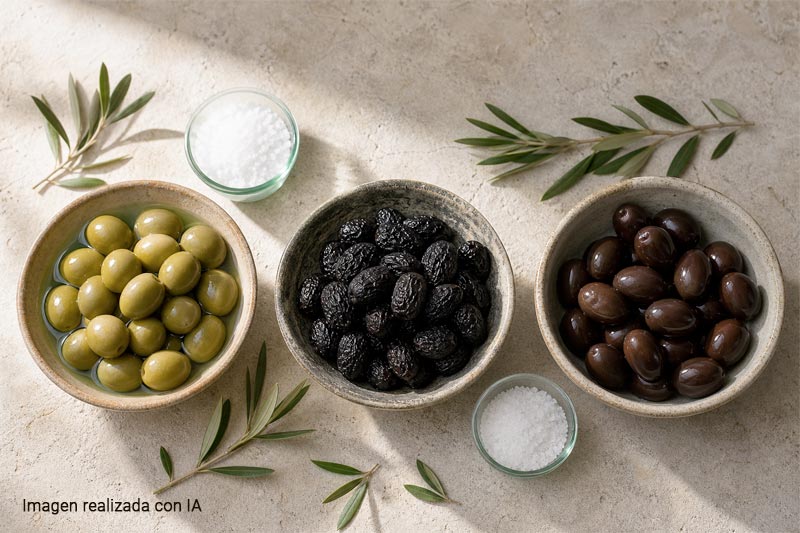
International technical standards recognize three major styles of table olive processing, which account for the bulk of world production: the Spanish or Sevillian style, natural fermentation or Greek style, and black olives by alkaline oxidation or Californian style.
Spanish/Sevillian style: the world’s most widespread method
The Spanish or Sevillian style, also called lye-treated or “cooked” processing, is the most widely used method worldwide and accounts for roughly 50% to 60% of all international table olive production. The process applies exclusively to olives picked while still green, before the onset of ripening, and consists of three clearly defined phases:
- Alkaline treatment (“cooking”): the olives are immersed in a sodium hydroxide (NaOH) solution, typically at concentrations of 2% to 5%, which penetrates the flesh and rapidly breaks down the oleuropein responsible for bitterness.
- Washing: after the alkaline treatment, the fruit is washed repeatedly with water to remove any residual caustic soda, a critical step for both product safety and the subsequent development of fermentation.
- Lactic fermentation in brine: finally, the olives are placed in a brine with sodium chloride concentrations of between 8% and 11%, where lactic acid fermentation takes place, driven mainly by Lactobacillus plantarum bacteria, lowering the pH to values between 4.5 and 4.8.
This method allows for very rapid debittering, taking just a few hours, which explains its industrial popularity and its ability to meet large-scale production demands. It is the characteristic style for varieties such as Manzanilla or Gordal, and produces the whole, split, pitted, or stuffed green olive profile that dominates shelves worldwide.
Natural fermentation or Greek style: the most traditional method
Natural fermentation, also known as the Greek style, is the oldest method and most closely respects the fruit’s spontaneous biological process, without resorting to any alkaline treatment. The olives, generally harvested at an advanced ripeness stage (black or turning color), are placed directly into a brine with salt concentrations of 8% to 10%, where bitterness is gradually reduced over several weeks or even months, while lactic fermentation develops simultaneously.
This process is considerably longer than the Spanish style—it can take between 40 days and several months—but produces a much more complex sensory profile, with residual bitter notes appreciated by gourmet consumers, and a characteristically more wrinkled texture in black varieties. Moreover, since no alkali is used, this 100% natural brine fermentation optimally preserves the lactic bacteria beneficial to gut microbiota, an aspect especially valued from a nutritional standpoint.
Californian style: black olives through oxidation
The Californian or American style is used specifically to produce uniformly colored, firm-textured black olives, commonly found in canned preserves and widely used in fast food and pizza industries. Unlike the previous methods, the darkening of the fruit here is not due to natural ripening or fermentation, but to a controlled alkaline oxidation process: green olives undergo successive treatments with sodium hydroxide at concentrations of 1% to 4%, alternated with air injections that oxidize the fruit’s phenolic compounds and generate that characteristic uniform black color.
After the oxidation process, the product is stabilized through heat treatment, since, without lactic fermentation to naturally acidify the medium, the Californian style almost always depends on subsequent sterilization or pasteurization to guarantee its microbiological safety. This is precisely one of the most direct connections between curing methods and the thermal preservation treatments covered in detail in our dedicated article on olive pasteurization.
The relationship between curing method and pasteurization
As explained in depth in our previous article on pasteurized and non-pasteurized olives, the need to apply heat after packaging depends directly on whether the product achieves, on its own, a pH and salt concentration sufficient to inhibit microbial growth. This is where the chosen curing method becomes decisive: while complete lactic fermentation, typical of the Greek style or a well-executed Spanish style, can naturally lower the pH to safe levels (below 4.5), the Californian style, being based on alkaline oxidation without significant acid fermentation, rarely reaches those thresholds on its own and almost always requires a subsequent heat preservation treatment.
In other words: the curing method not only defines the olive’s flavor and texture, but also determines its subsequent need for pasteurization. This relationship explains why certain varieties and formats—such as whole Californian-style black olives in cans—almost always appear pasteurized on the label, while certain traditional brine fermentations can be sold without this additional treatment when they meet the physicochemical parameters required by regulations.
Other artisanal home-curing methods
Beyond the three major industrial styles, there are more traditional, home-scale or artisanal methods worth knowing to understand the diversity of the sector:
- Water curing: involves soaking the olives in clean water, changing it daily for 7 to 20 days, until they gradually lose their bitterness through simple leaching of the oleuropein.
- Dry salt curing: the olives are layered alternately with coarse salt (roughly 500 g of salt per kilo of fruit) for several weeks, in a process that causes partial dehydration and produces wrinkled olives with a very concentrated flavor.
- Cracked or split olive curing: by mechanically breaking the fruit before soaking it in water or brine, the debittering process is significantly accelerated, since the skin barrier is removed and the flesh is directly exposed.
These methods, although less relevant from a large-scale industrial production standpoint, explain the origin of many traditional seasoned olive recipes still made at home and in small family mills across the Mediterranean.
Comparison of the three main methods