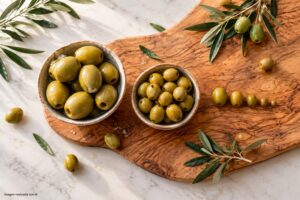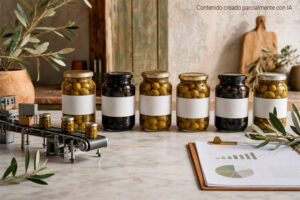
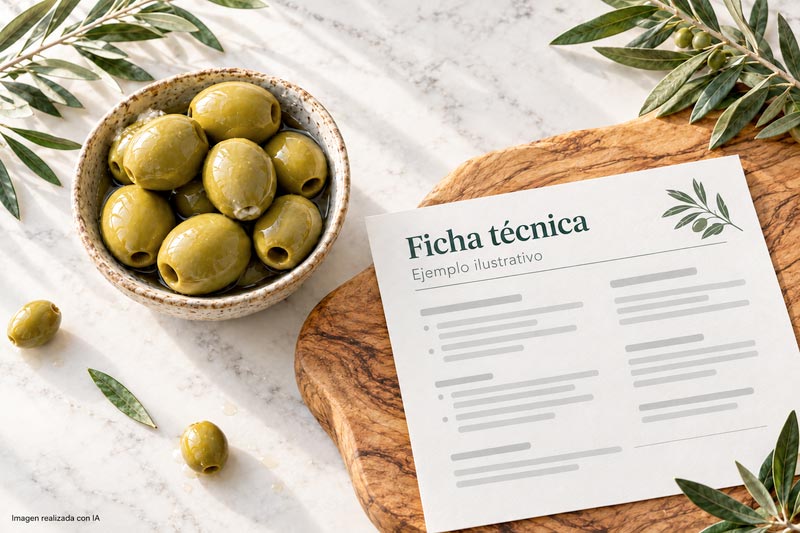
When a business buys table olives, pickles, gildas, pinchos or banderillas for resale, food service or further processing, the decision cannot be based solely on the price per pack or the product’s appearance. One document brings together essential information on composition, safety, yield and storage: the technical data sheet.
Knowing how to interpret it correctly is a professional skill. A well-prepared olive technical data sheet helps buyers compare offers from different suppliers, assess a product before approving it for a retail range or menu, calculate the actual cost per portion, anticipate labelling requirements and avoid unexpected issues with logistics, storage or shelf life.
In this article, we examine, section by section, the information typically included in a technical data sheet for olives and pickles, how to assess it critically and which details warrant additional verification before signing a supply contract.
A technical data sheet is the document in which a supplier provides a precise description of a food product. It should not be confused with the label intended for the end consumer: the technical data sheet is generally more detailed and designed for professional buyers, although much of its content overlaps with the mandatory labelling information governed by Regulation (EU) No 1169/2011 on the provision of food information to consumers.
In the table olive sector, the technical data sheet serves three purposes:
A buyer who compares unit prices without reading the technical data sheet may be comparing products that only appear equivalent. Two products with the same net weight may contain different quantities of drained olives, different size grades, different seasonings or different shelf lives.
The first section of any technical data sheet answers the question: what exactly am I buying?
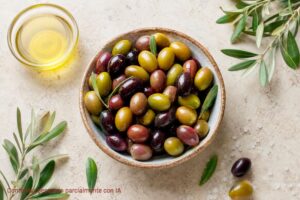
The name of the food and the list of ingredients are among the mandatory particulars established by Article 9 of Regulation (EU) No 1169/2011. For olives, the product name should be read alongside the variety: Manzanilla, Gordal, Cuquillo, Arbequina, Hojiblanca and Kalamata are not interchangeable, even when they share the same presentation and size grade.
A professional technical data sheet specifies the olive variety used. If it only states “green olives”, it is reasonable to ask the supplier for clarification.
Country-of-origin information is also governed by European labelling legislation. For products processed in Spain using either Spanish or imported raw materials, check whether the data sheet distinguishes between the origin of the olives and the place of processing.
Spain’s quality standard for table olives, established by Royal Decree 679/2016, applies to table olives processed and marketed in Spain and sets requirements for defects and tolerances. If a technical data sheet states a product’s commercial grade, this helps buyers anticipate the level of uniformity and overall quality to expect from the batch.
The data sheet indicates whether the olives are whole, pitted, stuffed, cracked, slit or sliced. This distinction is essential because it affects kitchen handling and how the declared size grade should be interpreted.
This section describes how the olives have been processed before packing. For olives, the processing method determines flavour, texture and the final sensory profile.
The three main methods recognised by international standards are Seville or Spanish-style processing, natural fermentation or Greek-style processing, and darkening by alkaline oxidation or Californian-style processing, as Olives GARCÍA explains in its guide to olive curing methods. Technical data sheets often refer to these processes using terms such as “lye-treated”, “natural”, “seasoned” or “brine-fermented”.
The list of ingredients must be headed by the word “ingredients” and presented in descending order of weight, as established by Regulation (EU) No 1169/2011. Olives and pickles commonly contain water, salt, vinegar, olive oil, spices, flavourings and additives identified by their E numbers.
The technical data sheet should describe the ingredients accurately, including the technological function of each additive. For example, the Olives García Chupadedos technical data sheet lists antioxidants, preservatives, flavour enhancers, an anti-caking agent and an acidity regulator, together with their corresponding E numbers.
Regulation (EU) No 1169/2011 requires the declaration of any ingredient or processing aid listed in Annex II that causes allergies or intolerances and remains present in the finished product. The name of that substance must be emphasised typographically in the ingredients list. It is important to distinguish this mandatory declaration from precautionary warnings, which manufacturers include when they consider them necessary.
When reading the data sheet for a specific product, check its declared allergenic ingredients and any applicable precautionary warnings. One real example is the description of Olives García Thin Gherkins, which mentions a packing liquid containing mustard. Mustard is listed in Annex II of the Regulation, so its presence should be verifiable in the product information. The Chupadedos data sheet carries a different warning: “may contain sulphites”. Every product is different, and its composition should not be inferred from its commercial name or flavour.
The mandatory nutrition declaration includes the energy value and the amounts of fat, saturates, carbohydrate, sugars, protein and salt, in accordance with Article 30 of Regulation (EU) No 1169/2011, which also provides exemptions for certain products.
Salt content is particularly relevant for table olives. When reading the data sheet, check the salt value declared for that specific product, its unit of measurement and the basis of calculation: whether it is expressed per 100 grams of drained product or per 100 grams of product as sold. This distinction affects comparisons between products and how product information is communicated.
The technical data sheet generally expresses energy in kilojoules and kilocalories per 100 grams, together with a breakdown of macronutrients. The Chupadedos data sheet, for example, declares energy, fat and saturates, carbohydrate and sugars, protein and salt per 100 grams of product. These values can be used to complete nutritional documentation for institutional catering or to explain the product’s nutritional profile.
This is one of the most practically useful sections for professional buyers.
Net weight is the weight of the packed product together with its packing liquid, excluding the packaging itself. Drained net weight—sometimes abbreviated as PNE on Spanish data sheets—is the weight of the product after the brine or other packing liquid has been removed. European legislation governs the indication of drained weight for foods presented in a liquid medium, while the Spanish quality standard for table olives sets specific criteria for whole, pitted and stuffed olives in non-transparent containers.
Comparing offers without considering drained weight is one of the most common mistakes when purchasing olives and pickles. The most useful cost calculation is the cost per kilogram of drained product. However, drained weight does not automatically equal usable yield: for olives with stones, products requiring preparation or applications involving processing losses, the actual yield depends on the intended use.
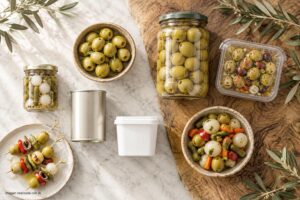
The technical data sheet links each product to its available pack formats. Olives GARCÍA offers glass jars, PET jars, PVC buckets, tinplate cans and large-capacity drums, as detailed in its article on packaging formats for olives, pickles and skewers. Check the weights and secondary packaging configuration specified for the exact format you need, and ask the supplier for any missing information: units per case, pallet configuration or supply conditions.
This information helps buyers calculate the cost per kilogram of drained product and plan warehouse space and goods-receiving logistics.
For whole olives, the technical data sheet specifies the size grade, expressed as the number of olives per kilogram. The Olives García Manzanilla product page, for example, lists six size ranges for this variety; the lower the number, the larger the olive. For pitted and stuffed presentations, international industry standards express size grade by reference to the original whole olive, a detail that prevents misleading comparisons. Size availability depends on the variety and the harvest season, so it should be confirmed with the supplier.
The technical data sheet describes storage and transport conditions, and it should be read with two distinct situations in mind: storage of the unopened container and instructions after opening. These are not interchangeable. The Chupadedos data sheet, for example, states that the product should be kept in a cool, dry place, away from heat sources, and refrigerated after opening. Specific times and conditions must be checked on each product’s data sheet rather than assumed to apply across the range.
Olive technical data sheets generally state whether the product has undergone a preservation heat treatment, such as pasteurisation. As Olives GARCÍA explains in its article on olive pasteurisation, this process acts as an additional safety barrier when the product’s acidity, salt concentration or degree of fermentation is not sufficient on its own to ensure preservation.
A data sheet that explicitly states the treatment applied gives buyers relevant information about safety and expected shelf life. The treatment required varies by product and should not be inferred solely from whether the olives are cracked, pitted or stuffed: check what the data sheet declares for each product.
Shelf life can vary significantly depending on the product, pack format, treatment applied and storage conditions. It must be verified for each product and pack format using the current technical data sheet, rather than extrapolated from one product to another.
The Olives García Chupadedos technical data sheet, updated in January 2023, declares different shelf lives for pasteurised and non-pasteurised formats. This example illustrates why reading this information is essential for managing stock rotation, safety stock and expiry dates. However, the specific values should always be checked against the current data sheet for each product.
More comprehensive technical data sheets include two quality-control sections.
These describe the product’s characteristic texture, colour, smell and flavour. Expressions such as “firm to the touch” or “characteristic flavour” define the expected sensory specification and provide a reference in the event of a complaint or batch audit.
These establish the microbiological limits specified for the finished product. The Chupadedos data sheet, for example, specifies the absence of Escherichia coli and Staphylococcus aureus, together with maximum counts for mesophilic aerobic microorganisms and Enterobacteriaceae.
These values help buyers assess the rigour of a supplier’s quality control. Keep in mind that the microbiological limits set out in a specification are not the same as the analytical results for an individual batch.
In addition to reading the technical data sheet, professional buyers should check:
This is the most costly mistake. Cost per kilogram of drained product provides the strongest basis for comparing offers, provided it is considered alongside the actual yield for the intended use.
Additives and allergens affect legal compliance, product communication and suitability for particular customers.
Under international standards, the size grade declared for pitted and stuffed olives refers to the original whole olive. Overlooking this detail can lead to misleading comparisons between products.
The same product may have different shelf lives depending on the pack format and heat treatment applied. Approving a product without checking this information can undermine stock-rotation planning.
A technical data sheet should be confirmed as the approved, up-to-date version. Including a revision date is good practice; its absence is a reason to ask the supplier for clarification.
It is the document in which a supplier precisely describes a product: product name, variety, ingredients, additives, allergens, nutritional information, size grade, pack formats, drained weight, heat treatment, storage conditions and shelf life.
The label is intended for the end consumer and contains the mandatory information required by Regulation (EU) No 1169/2011. The technical data sheet expands on this information with details relevant to professional buyers, such as microbiological parameters, secondary packaging and logistics requirements.
It is the weight of the product after the packing liquid has been removed. It allows buyers to calculate the cost per kilogram of drained product and compare offers from different suppliers, although usable yield also depends on the intended use.
This depends on the individual product. The technical data sheet should identify any allergenic ingredients listed in Annex II that are present in the product; precautionary warnings such as “may contain” are included when the manufacturer considers them necessary. For example, Olives García Thin Gherkins are described as being packed in a liquid containing mustard, while the Chupadedos data sheet warns that the product may contain sulphites. Composition must be verified on each data sheet, not inferred from the product name.
Pasteurisation acts as a safety barrier when the product’s acidity, salt concentration or degree of fermentation is not sufficient on its own to ensure preservation, as Olives GARCÍA explains in its article on pasteurisation. The treatment applied must be checked on each product’s data sheet.
It depends on the product, pack format, heat treatment and storage conditions. Shelf life must be verified on the current technical data sheet for each product and should not be assumed to be the same across different products.
Size grade is expressed as the number of olives per kilogram. A lower number indicates a larger olive. For pitted and stuffed olives, the declared size grade refers to the original whole olive.
Certifications such as IFS Food, BRC Global Standard for Food Safety and ISO 22000, together with the implementation of HACCP, are commonly required in the sector, as outlined in the Olives GARCÍA guide to choosing a supplier. These private certifications should be distinguished from legal requirements.
The technical data sheet for olives and pickles turns a visual impression into a verifiable specification. Ingredients, allergens, size grade, drained weight, heat treatment and shelf life all form part of the same professional purchasing decision.
Olives GARCÍA produces and markets table olives, pickles, gildas, pinchos and banderillas, with technical data sheets available for its products and a wide range of pack formats for distribution, restaurants, hotels, catering and the food industry. To identify the right product, ask the sales team for the latest technical data sheet and specify the intended use, sales channel and volume required. Reading the full data sheet helps buyers find the right balance between safety, yield and cost.