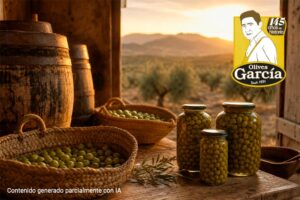
In a small town in the comarca of La Vall d’Albaida, in the province of Valencia, one family has been dedicated to the same trade since 1881: transforming the olive from the field into a benchmark gastronomic product. That family is the García family, and their legacy today is Olives García, S.A., a company that now boasts 145 years of history and has passed through five generations without ever losing its artisanal essence.
This article traces the brand’s complete journey, from its humble beginnings as an itinerant olive trade to the modern industrial enterprise it is today, with more than 4,000 square metres of facilities and a presence in both domestic and international markets.
The origin: Juan Bautista García Vaño and the itinerant trade
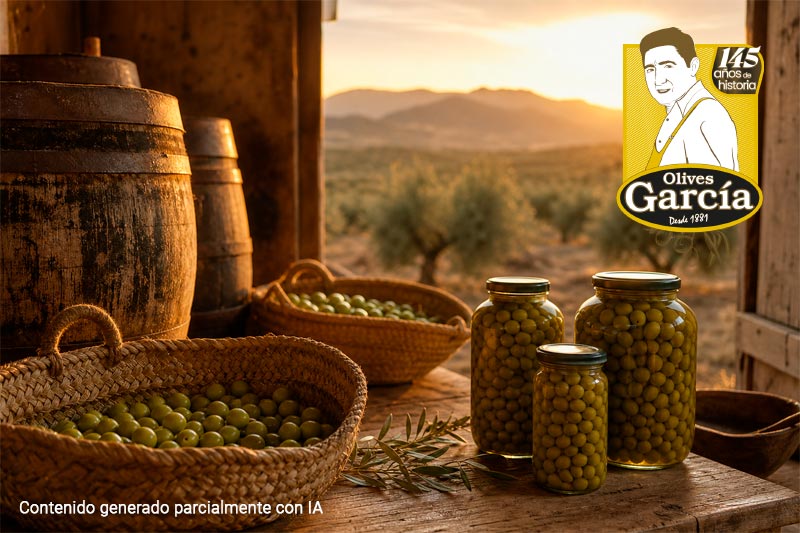
The story of Olives García begins in 1881 with Juan Bautista García Vaño, a countryman who started out selling the olives he harvested himself. In those days, the activity was limited to the direct sale of freshly harvested fruit, with no industrial processing whatsoever: it was the work of a farmer who, alongside cultivating the land, sold his own harvest in the local markets of rural nineteenth-century Valencia.
This founding first stage is what allows the brand today to claim genuinely artisanal origins rooted in the land, a brand asset that few companies in the sector can substantiate with the same documented longevity.
Second generation: territorial expansion of the trade
The baton then passed to his son, Juan Bautista García Sanz, who continued selling olives while widening the family business’s reach to other towns in the comarca. This step, seemingly modest, proved decisive: it transformed a local subsistence business into a commercial venture with territorial reach, laying the groundwork for what would later become a genuine distribution company.
Third generation: the birth of a dedicated warehouse and industrial production
The company’s most significant qualitative leap came with the third generation, led by Juan García Llopis. Under his direction, Olives García acquired its own warehouse dedicated to the production of olives and pickles, expanding the business into new sales channels and definitively leaving behind the model of a mere harvest reseller. This moment marks the García family’s transition from traders of an agricultural product to genuine industrial processors, with their own processing facilities.
This milestone is particularly significant from a food technology standpoint: having its own facilities allowed the family to begin directly controlling the curing and pickling processes of its olives, rather than relying on third parties, laying the foundations for the culture of quality the brand upholds to this day.
Fourth generation: a commitment to gastronomy and quality
With the arrival of the fourth generation, the company made an explicit commitment to developing products of a high gastronomic standard, careful quality, and constant adaptation to market needs and trends. It was during this stage that the brand began actively positioning itself as a benchmark firm in the Valencian Community, moving beyond a purely local scope and gaining visibility in an increasingly competitive market.
This generation was also responsible for laying the strategic foundations of diversification that would, years later, lead to the launch of new in-house brands within the group.
Fifth generation: technology, diversification and international expansion
Today, the fifth generation of the García family leads the business, combining more than 140 years of accumulated experience with the adoption of the latest quality control, packaging and distribution technologies. The company now has a young, qualified and committed team, characterised by teamwork and an ongoing effort to deliver attentive customer service.
Under this generation, the brand took a key strategic step in 2017 with the launch of La Sénia, its second in-house brand, conceived specifically to open the way into new markets beyond Olives García’s traditional catalogue. This is complemented by García Gourmet, another in-house line that expands the portfolio with olive presentations such as Split, Anchovy Flavour, Cocktail, Gazpachera and Mojo Picón, among other varieties.
The current facilities, located on Avenida Pintor Gomar in Benigànim, span more than 4,000 square metres divided into specialised areas for production, storage and dispatch, reflecting the industrial scale the company has achieved without abandoning its artisanal roots. The company, legally incorporated as a Sociedad Anónima (public limited company) in 1984 — formalising a family activity that already dated back a century — maintains its registered office in the very town where it all began.
A legacy underpinning today’s value proposition
Olives García’s trajectory illustrates a pattern rarely seen in the Spanish agri-food sector: the uninterrupted continuity of the same family at the helm of a business for 145 years, spanning the industrialisation of the twentieth century and the digitalisation of the twenty-first without ever losing control or the family identity of the project. This continuity is not merely a narrative device for brand marketing, but a tangible guarantee of accumulated knowledge about the product, the local olive varieties, and the production processes that can only be acquired through generations of hands-on practice.
Today, combining that heritage with investment in quality control, packaging and distribution technology allows Olives García to present itself to hospitality and distribution clients as a brand offering, in equal measure, the traceability and know-how of a traditional product alongside the operational reliability of a modern industry.