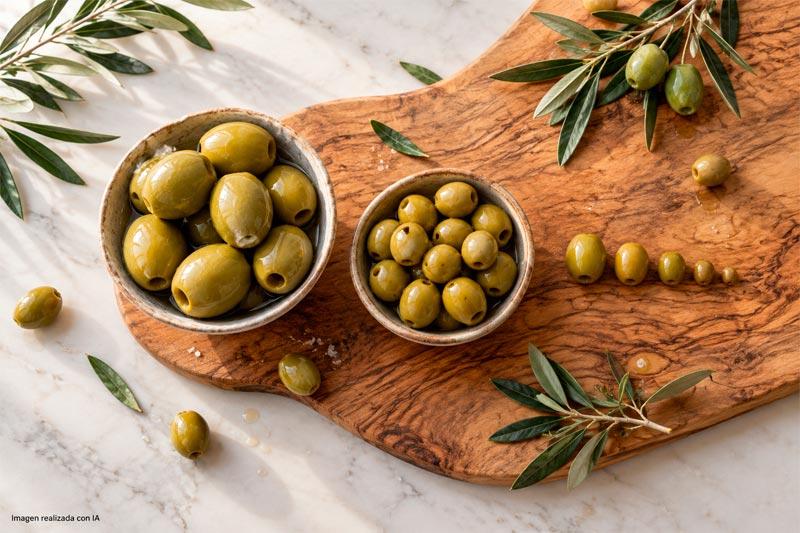
Olive calibre expresses size according to the number of fruits contained in one kilogram. It therefore works in the opposite way to what many people expect: the lower the calibre numbers, the larger each olive. A 60/70 calibre contains between 60 and 70 olives per kilogram, while a 201/230 calibre contains between 201 and 230; the olives in the first group are considerably larger.
Understanding this figure is important for professional buyers because size affects visual presentation, the approximate number of units per pack or serving, product consistency and suitability for each application. However, calibre should not be assessed in isolation. The variety, presentation — whole, pitted, stuffed or sliced — flavour, texture, packaging format and intended use must all be considered as part of the same purchasing decision.
Olives GARCÍA works with a wide range of olives, including Manzanilla, Gordal, black, seasoned, pitted, stuffed and sliced varieties, as well as gastronomic specialities. This diversity makes it possible to assess the product, calibre, preparation and format together, adapting supply to the requirements of retailers, hospitality businesses, hotels, caterers and food manufacturers.
Calibre is a size classification based on the number of olives per kilogram. The international standards of the International Olive Council and Codex use this system, with a scale beginning at 60/70 and continuing through successive ranges such as 71/80, 81/90, 91/100, 101/110, 111/120, 121/140, 141/160, 161/180, 181/200 and 201/230, followed by additional ranges up to 381/410. Above 410, the international scale uses intervals of 50 fruits.
The figure does not indicate diameter in millimetres or the exact weight of each olive. It indicates how many units from a graded batch are needed to make up one kilogram. A lower numerical range therefore corresponds to heavier and, in general terms, larger olives.
The interpretation is straightforward:
161 is the minimum number of olives per kilogram.
180 is the maximum number of olives per kilogram.
The batch must fall within this range and meet the applicable uniformity criteria.
In general terms, it will be larger than a 201/230 calibre and smaller than a 121/140 calibre.
This classification system provides suppliers and buyers with an objective reference. Simply requesting a “large olive” can be ambiguous; specifying the variety, presentation and calibre produces a much more precise purchasing specification.
The practical rule to remember is:
Fewer olives per kilogram mean larger olives; more olives per kilogram mean smaller olives.
| Indicative calibre | Fruits per kilogram | Approximate size |
|---|---|---|
| 60/70 | Between 60 and 70 | Very large |
| 91/100 | Between 91 and 100 | Large |
| 121/140 | Between 121 and 140 | Large |
| 161/180 | Between 161 and 180 | Medium-large |
| 201/230 | Between 201 and 230 | Medium |
| 261/290 | Between 261 and 290 | Medium-small |
| 321/350 | Between 321 and 350 | Small |
| 381/410 | Between 381 and 410 | Very small |
The descriptions “very large”, “medium” and “small” in the table are indicative rather than universally required designations. In professional operations, it is preferable to work with the numerical range, as different markets, countries and suppliers may use different commercial names for similar sizes. Codex also allows alternative scales or designations when agreed between the parties.
Calibre does more than separate large olives from small ones. It is also linked to batch uniformity, which is particularly important when the product is displayed in a transparent jar, served directly at the table or expected to maintain a consistent appearance across different packs.
Current Spanish regulations require whole, pitted, stuffed and halved olives to be uniform in size within their variety. If olives of different sizes from the same variety are used, this must be stated in the information provided to consumers.
As an international reference, Codex establishes that, in a sample of 100 olives, once the fruits with the largest and smallest equatorial diameters have been removed, the difference between the diameters of the remaining olives must not exceed 4 millimetres. It also provides alternative tolerances for fruits above or below the specified calibre: 10% for intervals of 10 fruits, 5% for intervals of 20 and 2% for intervals of 30 or more.
For buyers, this has a practical implication: knowing the nominal range is not enough. When visual consistency or portion control is essential, uniformity should be included among the criteria used to approve both the sample and the technical specification.
Two olives of the same calibre can offer very different characteristics if they belong to different varieties. Size must always be considered alongside the shape of the fruit, flesh-to-stone ratio, firmness, texture, ripeness and preparation method.
The Gordal variety is known for its large size. The Protected Geographical Indication for Aceituna Gordal de Sevilla includes calibres ranging from 60/70 to 121/140, while the Protected Geographical Indication for Aceituna Manzanilla de Sevilla covers ranges from 141/160 to 321/350. These intervals demonstrate why the figures should not be compared without first identifying the variety.
The International Olive Council considers fruits weighing between 3 and 5 grams to be medium-sized and those weighing more than 5 grams to be large. It also states that a flesh-to-stone ratio of 5:1 is acceptable and that a higher ratio increases commercial value. For professional purchasing decisions, calibre therefore provides useful information but does not replace other physical and sensory attributes.
With whole olives, calibre is immediately apparent. Larger sizes provide greater visual impact in aperitifs, bars, buffets and gastronomic presentations. Medium or small sizes may be suitable for larger servings, mixed products or services in which a more compact individual piece is preferred.
With pitted olives, the number of pieces contained in one kilogram changes when the stone is removed. For this reason, international standards state that the declared calibre must correspond to that of the original whole olive, using the coefficient established by each producing country to verify it.
This distinction prevents the direct comparison of the count for an olive with its stone and one that has already been pitted. Requests for quotations should therefore specify whether the required range refers to the original whole fruit.
Calibre is particularly noticeable in stuffed olives because it affects both the proportion of fruit to filling and the appearance of the finished product. For stuffed olives, Codex provides intervals of 20 fruits from 201/220 to 401/420 and establishes that, once the filling has been removed, the indicated size corresponds to the original whole olive.
For retail, tapas and cocktail applications, uniform pieces help to maintain consistency between units. The selection should also take into account the type and proportion of filling, flavour profile and drained net weight of the pack.
When olives are used sliced, chopped or incorporated into pizzas, salads, sauces, savoury baked goods or prepared meals, the priority may shift from the visual impact of the whole fruit to industrial yield, consistency of cut and even distribution of the ingredient.
In these cases, a large size is not automatically the best option. Buyers must consider the cutting specification, the required number of slices or pieces, cost per serving, handling requirements and the product’s performance in the recipe.
Not necessarily. Calibre and quality are not the same thing. Calibre classifies olives by size, while commercial quality also takes into account the condition of the fruit, defects, ripeness, colour, flesh integrity and other requirements.
Spanish regulations distinguish between Extra, First or Select, and Second or Standard categories, establishing requirements relating to defects and permitted tolerances. They also require olives to be sound, clean, free from unusual odours or flavours and free from defects that could compromise their suitability for consumption or preservation.
A large olive may be visually impressive, but this alone does not guarantee a higher category, a particular texture or suitability for every application. Equally, a smaller calibre may be precisely what is required for a particular recipe, portion-cost calculation or packaging format.
The right choice is not always the largest olive. It is the olive that offers the best balance between variety, size, presentation, quality, application and cost.
In retail, calibre influences how the product is perceived through its packaging, particularly when the container is transparent. A large olive can reinforce a premium or gourmet proposition, while medium calibres can be used to create versatile, family-oriented products.
Purchasing managers should consider how calibre fits into the positioning of the range: target price, variety, drained weight, approximate number of units, packaging format, container transparency and visual comparison with other products on the shelf. If the range includes different sizes, its architecture should clearly explain the benefit of each option.
In hospitality, the best choice depends on the type of service. For a complimentary olive, aperitif or tapa, factors such as how easy it is to eat, the number of units per serving and the actual cost of each service all matter. A large, fleshy olive may provide greater visual impact for a gourmet offering, while another range may be more efficient for salads, recipes or accompaniments.
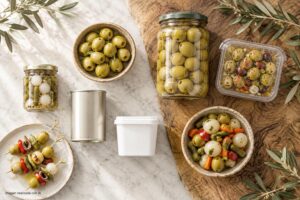
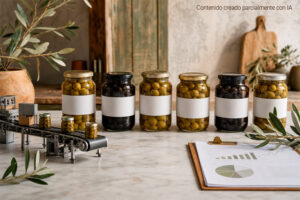
The rate at which packs are opened, available storage space and supply format must also be taken into account. Olives GARCÍA offers glass jars, PET containers, buckets, tins and high-capacity containers, allowing the size of the fruit to be coordinated with consumption levels and the establishment’s operating requirements.
At buffets and events, uniformity supports a consistent presentation. For banquets and catering services, knowing the approximate number of pieces per kilogram helps to estimate units and portions, although the final calculation should always be based on the product’s actual drained weight and technical specification.
When olives are incorporated into skewers, gildas or repeated assemblies, the relationship between size, ease of handling and proportion compared with the other ingredients is particularly important. An olive that is too large or too small can affect both the visual balance and operational efficiency of the finished product.
For manufacturers of prepared meals, pizzas, salads, sauces and other convenience foods, calibre should be specified together with the presentation and applicable tolerances. The objective is usually to ensure process consistency, uniform performance and predictable yield.
Purchasing specifications may include the variety, original calibre, type of cut, permitted percentage of broken pieces, drained weight, packing medium, sensory requirements and logistics format. Olives GARCÍA offers whole, pitted, stuffed and sliced olives, as well as packaging solutions for different channels and volume requirements.
The Olives GARCÍA Manzanilla olive product information describes this variety as cooked, whole and seasoned, available with either anchovy flavour or natural flavour. The company publishes six calibre ranges: 140–160, 160–180, 180–200, 200–220, 240–260 and 280–300.
This breadth makes it possible to adapt the same variety to different objectives. The lower ranges provide larger olives with greater visual presence, while the higher ranges contain more units per kilogram and smaller individual pieces. The product is available in different professional packaging formats, from glass and PET to tins and 5 or 10 kg buckets, enabling the Manzanilla olive calibre to be matched to the required turnover and sales channel.
The specific availability of each combination of calibre, preparation and format should be confirmed with the sales team. Calibre is an agricultural characteristic, and available volumes may depend on the variety and each harvest.
To compare proposals on a like-for-like basis, a professional request should not be limited to “large green olives”. It is advisable to include:
Variety: Manzanilla, Gordal, black or another variety.
Preparation: natural, Sevillian-style, seasoned, oxidation-blackened or another method.
Presentation: whole, pitted, stuffed, sliced or chopped.
Calibre: required range and applicable tolerance.
Commercial category: where relevant.
Sensory profile: firmness, flavour, salt level or type of seasoning.
Format: glass, PET, bucket, tin or high-capacity container.
Weight: net and drained net weight.
Intended use: aperitif, stuffing, buffet, ingredient, processing or resale.
Volume and logistics: expected consumption, units per case, pallet configuration and delivery frequency.
A precise definition helps the supplier recommend the right product and prevents comparisons between products that only appear to be equivalent. Two quotations may state the same net weight while corresponding to different varieties, calibres, presentations and yields.
This is the most common mistake. With olive calibre, the numbering system is inverse to size: 80/90 is larger than 240/260.
Visual presentation matters, but it does not always determine the best performance. A very large olive may be ideal for a premium tapa but impractical for a recipe that requires the ingredient to be evenly distributed.
Shape, flesh, stone and texture depend on the variety. Calibre must be assessed within this context rather than treated as an isolated figure.
For pitted and stuffed olives, international standards refer to the calibre of the original whole fruit. Overlooking this detail can lead to inaccurate comparisons.
The useful number of units for service should be calculated using the weight of the product rather than the combined weight of the product and its covering liquid. Spanish regulations establish specific drained net weight criteria for whole, pitted and stuffed olives in non-transparent packaging.
The same calibre can perform differently in a retail jar, a tapa, a gilda or a prepared-meal production line. Communicating the intended use enables the supplier to make a more accurate recommendation.
It means that one kilogram contains between 200 and 220 olives from the graded batch. Because the scale works in reverse, these olives are smaller than those in a 140/160 calibre and larger than those in a 280/300 calibre.
The 80/90 olive is larger. Fewer units are needed to make up one kilogram.
No. It indicates size through the number of fruits per kilogram. The quality category takes other factors into account, including defects, integrity, ripeness and the specific characteristics of the variety.
There is no single best calibre. A large olive may be suitable for a tapa or premium aperitif, while a medium size may work better in salads, mixed products or cooking. In industrial processes, yield and consistency may be the main priorities. The decision should take into account calibre, variety, serving size, cost and packaging format.
Under international standards, it is expressed using the calibre corresponding to the whole olive from which it came. To verify this, a coefficient is applied to the number of pitted olives per kilogram.
Not necessarily. Each variety has its own characteristics, and availability may vary according to the harvest, selection and product specification. For example, the certified ranges for Gordal and Manzanilla de Sevilla olives are different.
It can be used to estimate the number based on drained net weight, but it does not replace the technical specification. The final figure may vary within the range according to the applicable tolerances, presentation and preparation.
Olive calibre turns a visual perception — large, medium or small — into a measurable specification. To interpret it correctly, simply remember that the figure indicates the number of fruits per kilogram and that a lower number therefore corresponds to a larger olive.
However, the professional purchasing decision does not end there. The choice must take into account the variety, preparation method, presence or absence of the stone, culinary application, commercial positioning, number of units per serving, packaging format and logistics.
Olives GARCÍA offers an extensive selection of table olives for professional customers, together with packaging solutions adapted to retailers, hospitality businesses, hotels, caterers and food manufacturers. To define the most suitable product, provide the sales team with details of the required product, presentation, intended use, volume and preferred calibre range. A complete specification makes it possible to find the right balance between appearance, consistency, yield and cost.