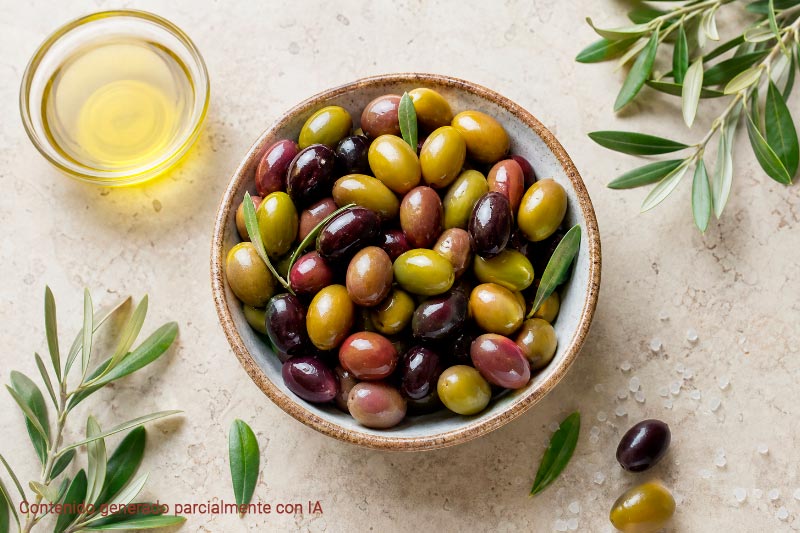
Table olives hold a unique place in the Mediterranean diet: they are not just a traditional snack, but a food with a nutritional profile backed by numerous scientific studies, comparable in many respects to the olive oil derived from them. From the standpoint of food technology and nutrition, understanding their composition helps explain why this small fruit of the olive tree has been part of healthy Mediterranean eating for centuries.
This article reviews, based on scientific evidence, the main nutritional benefits of olives: their fat profile, their antioxidant content, their role in cardiovascular health, and other relevant effects documented in specialised literature.
Nutritional composition: what’s really in an olive
Every 100 grams of olives provide approximately 115 kcal, 0.8 g of protein, 10.7 g of fat (of which 7.5 g are monounsaturated fatty acids), 6.3 g of carbohydrates, and 3.2 g of fibre. Calorie content varies according to variety and ripeness: black olives, having remained on the tree longer, have a higher fat content (around 30%) compared with 15% in green olives, which explains their higher energy value.
This profile makes the olive one of the few fruits naturally rich in healthy fats, a trait it shares with avocado and nuts, clearly setting it apart from most low-fat fruits and vegetables.
The nutritional star: oleic acid
The most notable component of the olive’s lipid profile is oleic acid, a monounsaturated fat from the omega-9 family that makes up between 70% and 80% of the fruit’s total fat, and up to 99% of its monounsaturated fatty acids. This same fatty acid is the main compound responsible for the heart-healthy properties attributed to extra virgin olive oil, which explains why the whole olive shares much of that beneficial profile even before being pressed.
Multiple studies agree that monounsaturated fats such as oleic acid help improve the plasma lipid profile, increasing “good” HDL cholesterol and reducing “bad” LDL cholesterol, a mechanism directly linked to reduced cardiovascular risk.
Antioxidants and phenolic compounds: the other major advantage
Beyond its fats, the olive stands out for its high content of antioxidant phenolic compounds, particularly hydroxytyrosol, tyrosol, and oleuropein. These compounds directly neutralise free radicals and also stimulate the production of endogenous antioxidants such as glutathione, according to studies analysing the effects of olive pulp consumption in healthy volunteers.
Specific research on these polyphenols has shown that they prevent the oxidation of LDL cholesterol, a key process in the development of atherosclerosis, reinforcing the olive’s protective cardiovascular role. In addition, the vitamin E present in the fruit—covering around 12-15% of the recommended daily intake per 100 grams—complements this antioxidant action, protecting cells against the oxidative damage generated by normal metabolic processes in the body.
Scientific evidence on cardiovascular health
The link between olive consumption and cardiovascular health is not merely a nutritional hypothesis; it is backed by direct experimental evidence. A preclinical study on hypertensive rats (SHR) demonstrated that regular consumption of table olives promotes measurable antihypertensive activity, as well as improving the lipid profile in healthy volunteers after one month of daily consumption, without increasing body weight or blood pressure.
This same study identified maslinic acid, oleanolic acid, hydroxytyrosol, and luteolin in blood plasma following daily olive intake—all bioactive compounds with demonstrated capacity to lower blood pressure, suggesting that daily consumption could directly contribute to improved cardiovascular health. Nutrition specialists also note that, thanks to their lipid similarity to olive oil, olives exert “a beneficial effect on blood pressure and on glycaemic control parameters.”
Fibre, satiety, and digestive health
Olives provide between 1.5 and 3.2 grams of dietary fibre per 100 grams, in the form of pectins, hemicellulose, cellulose, and lignin, making them a food with a beneficial effect on intestinal transit. Their combination of fibre and healthy fats also prolongs the feeling of satiety, a relevant factor in appetite control between meals, reinforcing their role as a recommendable snack compared with other ultra-processed options.
Notable micronutrients: vitamin E, iron, and calcium
In addition to their lipid and antioxidant profile, olives provide relevant amounts of micronutrients: vitamin E, or alpha-tocopherol, is the most notable, covering between 12% and 15% of the recommended daily intake per 100 grams, with a demonstrated role in cellular protection against oxidative damage. Black olives, in particular, provide notable amounts of iron (around 18% of the recommended daily value), a mineral essential for haemoglobin formation and the prevention of anaemia.
Animal studies have also shown that the olive’s antioxidant compounds, such as oleuropein and hydroxytyrosol, promote calcium fixation in bone, opening up a relevant line of research into their potential role in preventing bone demineralisation.
An important consideration: sodium content
Not every nutritional aspect of the olive is exclusively positive. Because their traditional processing requires brine, table olives have a considerably high sodium content, which can range between 5 and 8 grams of salt per 100 grams of product, and up to 735 mg of sodium according to some nutritional tables. This is especially relevant for people with high blood pressure, for whom nutrition specialists recommend moderating consumption or prioritising lower-salt variants.
This nuance is important from a standpoint of honest consumer communication: the same food that delivers cardiovascular benefits thanks to its fats and antioxidants requires, precisely because of its processing method, moderate consumption among specific risk groups, reinforcing the importance of informed, balanced consumption.
A functional food within the Mediterranean diet
The available scientific evidence confirms that the table olive is not merely a gastronomic accompaniment, but a functional food with a cardioprotective lipid profile, a notable contribution of polyphenolic antioxidants, and documented benefits for blood pressure, cholesterol, and digestive health. Its regular inclusion in the diet, within recommended amounts and with particular attention to sodium intake among hypertensive individuals, cements its place as a scientifically supported cornerstone of the Mediterranean eating pattern associated with longevity and the prevention of chronic diseases.